

Two-burner camping setups solve a familiar problem: camp meals need more capacity than a single-burner stove without demanding excessive counter space. I’ve organized this lineup around real use cases, from tent cooking to compact RV kitchens, trailer galleys, marine installations, and full oven-and-cooktop combinations.
The Coleman model is the simplest option for weekend trips, while the CAMPLUX selections serve more specialized needs involving built-in propane cooking, flame control, glass covers, or an integrated oven. Installation requirements and fuel format matter more than burner count alone, so I’ve kept those practical distinctions clear throughout the roundup.
A Quick View Of The Lineup

Coleman Portable Butane Stove Carrying Case

CAMPLUX 21-Inch RV Stove Oven Combo, 3 Burners, 28,100 BTU, Stainless Steel RGS21MSF

CAMPLUX 17-Inch RV Propane Stove Oven Combo, 3 Burners, 1.27 Cu. Ft. RGP17MGB

CAMPLUX Elite 21-Inch RV Stove Oven Combo, 1.8 Cu. Ft., 3 Burners, 28,100 BTU, Black
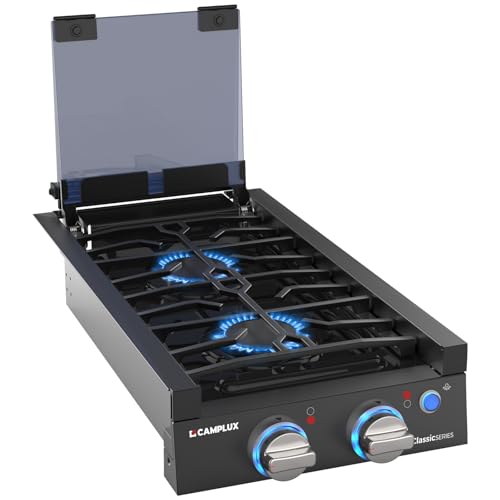
CAMPLUX 12-Inch 2-Burner RV Cooktop with Glass Cover, 13,000 BTU RGH12IB

CAMPLUX Classic 21-Inch 3-Burner RV Cooktop, 21,000 BTU, Black RGH21IB

CAMPLUX Elite 21-Inch 3-Burner RV Cooktop, 21,000 BTU, Glass Cover, Black

CAMPLUX 2-Burner RV Stove, Drop-In

CAMPLUX 30-Inch 1.5 Cu. Ft. Convection Microwave, Stainless Steel
The Strengths Of Each Pick
The Coleman is the option I’d consider for a weekend camp where carrying less matters more than a full kitchen. Its tabletop format avoids cabinetry, and the included case makes storage beside a tent or inside a vehicle less awkward.
That simplicity comes with limits, particularly for a group cooking several dishes. Unlike the CAMPLUX installations, this unit serves one compact cooking area rather than a permanent RV cooking station.
A Few Strong Suits
- The carrying case simplifies transport and storage.
- Matchless ignition removes the need to carry separate ignition supplies.
- The compact layout can support pans up to 10 inches.
- Tabletop placement needs no permanent kitchen opening.
Worth Noting
- The butane cylinder is sold separately, so complete cooking gear requires another purchase.
- Outdoor cooking surfaces need stable clearance and responsible canister handling.
Quick Facts
Made For
Weekend campers needing a lightweight, non-installed cooking station for simple meals.
Consider Something Else When
CAMPLUX RGH12IB suits RV owners who prefer built-in propane cooking and a covered surface.
For long-distance RV trips, a full oven-and-cooktop combination changes the daily meal equation. RGS21MSF combines three surface burners with a 1.8 cu. ft. oven, making it more useful than the portable Coleman for baking and substantial entrees.
The stainless steel exterior fits a more permanent kitchen, although the 21-inch width and installation demands make it less suitable for temporary camp use. For a mobile kitchen that genuinely needs both cooking zones, the added utility is clear.
Where It Excels
- Three burners permit several dishes to share the work surface.
- The 1.8 cu. ft. oven handles baking and larger meal preparation.
- Ambient oven illumination improves visibility inside the cooking cavity.
- Stainless steel suits a fixed RV or tiny-house kitchen.
Practical Considerations
- Freestanding installation requires suitable clearance, gas connection, and countertop support.
- The oven and cooktop create a much larger permanent footprint than a portable stove.
- More moving parts mean more surfaces that may require routine cleaning.
Right Fit For
RV households that regularly prepare multi-dish or baked meals away from home.
Look Elsewhere When
CAMPLUX RGP17MGB provides a narrower format for RV layouts unable to accommodate 21 inches.
RGP17MGB answers the same full-kitchen problem as RGS21MSF in a narrower package. Its 17-inch format is more believable inside a compact trailer or mini kitchen, where a 21-inch appliance could crowd the galley.
Three burners are paired with a 1.27 cu. ft. oven that offers a smaller cooking cavity. Depending on the menu, that trade-off may be reasonable, but frequent bakers will find RGS21MSF more accommodating.
Real Benefits
- The narrower body preserves useful galley space.
- Three burners support a complete camp meal setup.
- Flame failure protection is incorporated into the cooking design.
- Oven temperatures adjust from 300°F to 490°F.
Some Limits To Know
- The oven is smaller than the 1.8 cu. ft. cavity in RGS21MSF.
- A built-in gas range still requires compatible cabinetry and installation work.
- Dark exterior finishes may show cooking residue more readily than stainless steel.
Feature Snapshot
Built With In Mind
Narrow RV kitchens needing a three-burner cooktop and oven in one unit.
Another Choice May Suit
CAMPLUX RGS21MSF serves travelers who prioritize oven volume over a narrower installation footprint.
This 21-inch range combines the roomier oven seen in RGS21MSF with flame failure protection. That makes it the more considered option for full-time RV households that cook throughout the day and prefer a built-in kitchen rather than a table appliance.
The 1.8 cu. ft. oven is listed as suitable for an 8- to 12-pound turkey, which gives holiday cooking a concrete use case. The appliance remains a fixed installation, not a lightweight camp stove.
Points In Its Favor
- The larger oven supports more involved meals.
- Three burners keep sides and main dishes moving together.
- Flame failure protection adds a relevant built-in feature.
- Slide-in styling suits camper and mobile-home layouts.
Possible Compromises
- Owners must verify cutout dimensions and gas compatibility before ordering.
- Weekly travel makes a permanently installed range less convenient than the Coleman.
- The black finish calls for prompt grease cleanup to preserve its appearance.
Who Will Love This
Frequent RV travelers who want a roomy oven, three-burner surface, and flame monitoring.
Reach For A Different Pick When
CAMPLUX RGH12IB is easier to incorporate into a much smaller kitchen or galley.
RGH12IB brings the category back to a genuine two-burner layout. At 12 inches, it is the most compact built-in cooktop here, making it practical for a small trailer kitchen, food truck, or renovated utility vehicle.
The slide-in design keeps the finished counter line neat, while the foldable tempered-glass cover helps contain splashes when the burners are off. Unlike RGS21MSF, there is no oven, so this works best for sautéing, boiling, and skillet meals.
What Pays Off
- The narrow cutout preserves precious counter space.
- Two burners support a main dish and a side.
- The tempered-glass cover folds away and shields the surface between uses.
- The embedded appearance suits compact mobile kitchens.
Details To Watch
- Two burners offer less cooking flexibility than the 21-inch three-burner models.
- Installation requires matching the cutout and propane supply configuration.
- Glass surfaces need regular wiping to keep grease from becoming stubborn residue.
Core Details
The Right Fit
Small-space RV and specialty-vehicle kitchens that need two built-in burners.
Swap It Out When
CAMPLUX RGH21IB better serves galleys with room for three active cooking zones.
RGH21IB is a cooktop rather than a range, but its three-burner arrangement makes it more versatile than the true two-burner RGH12IB. It fits campers, motorhomes, and boats with enough galley width for a 21-inch opening.
Its 21,000 BTU output is shared across the cooking surface, so total heat output alone does not dictate heat on an individual burner. The slide-in format and tempered-glass cover prioritize a permanent, uncluttered kitchen.
Strengths Worth Knowing
- Three burners reduce cooking bottlenecks.
- The glass cover helps create a cleaner counter profile.
- Slide-in installation suits a broad range of mobile kitchens.
- Ignition choices add convenience for different electrical setups.
Factors To Consider
- There is no oven, so baking requires a separate appliance.
- Some ignition configurations require 12V DC power at 1A or less.
- A 21-inch opening rules out many compact galley layouts.
Who Should Grab It
RV and boat cooks wanting three burners without a full oven installation.
Skip It When
CAMPLUX RGH12IB is the more workable option for a narrow mobile kitchen.
This Elite cooktop adds flame failure protection to the three-burner format of RGH21IB. It is a natural upgrade for frequent campers, charter-boat cooks, or mobile households that place greater emphasis on burner monitoring during daily use.
The source specifies rotary piezoelectric ignition, which creates an electrical spark to start the gas without a continuous flame. That system requires a 12V DC connection drawing no more than 1A.
Notable Gains
- Flame failure protection distinguishes it from RGH21IB.
- Three burners support simultaneous meal preparation.
- The tempered-glass cover folds over the surface when needed.
- The slide-in design suits permanent mobile kitchens.
Details To Watch
- Flame failure protection does not replace proper fuel-system maintenance.
- Electrical access is required for piezoelectric ignition.
- Owners must confirm that a 21-inch cutout fits the available cabinetry.
Feature Facts
Best Suited To
Frequent RV and marine cooks who value flame monitoring and three-burner capacity.
A Better Fit Elsewhere
CAMPLUX RGH12IB fits travelers who prioritize a 12-inch footprint over three burners.
This drop-in cooktop pays particular attention to travel noise. Rubber rings hold the cooking grate in place, reducing the rattling and clanking commonly associated with a loose grate on rough roads.
A thermocouple is the temperature-sensing component used with flame failure protection to monitor whether a burner remains lit. That feature is especially relevant in a permanently installed RV or boat kitchen, although the appliance still needs careful fit planning.
What Works In Its Favor
- Rubber-ring grate support targets travel noise.
- Flame failure protection monitors an extinguished burner.
- The two-burner arrangement keeps the cooking surface focused.
- Drop-in installation suits a dedicated cabinet opening.
Honest Caveats
- Two burners are less adaptable than the 21-inch three-burner cooktops.
- Owners still need to check the cutout, gas connection, and ventilation requirements.
- Grate and burner crevices can collect grease during frequent use.
Whose Shelf It Belongs On
RV and marine cooks prioritizing a compact layout, flame monitoring, and less grate movement.
Where A Sibling Pick Shines
CAMPLUX RGH21IB is the stronger fit when simultaneous cooking on three burners matters more than a true two-burner layout.
The 30-inch convection microwave serves a different category entirely, so it earns inclusion only for kitchens where a wall-mounted cooking and ventilation unit is more realistic than a two-burner gas cooktop. It combines microwave cooking, convection baking, and overhead ventilation in one housing.
The 1.5 cu. ft. cavity may feel modest beside a full RV oven, but the installation could free a separate work surface. A 30-inch width makes it less practical for a narrow trailer, and an RV manufacturer’s ventilation requirements remain essential.
Reasons It Performs
- Microwave, convection cooking, and venting share one housing.
- The 1.5 cu. ft. cavity supports compact kitchen tasks.
- Stainless steel gives the appliance a restrained finish.
- The low-noise design suits occupied living spaces.
Less-Strong Areas
- A 30-inch installation requires more width than every portable cooktop here.
- It has no gas burners, so it does not satisfy a two-burner requirement.
- Overhead clearances and ventilation dimensions need careful verification.
Key Product Details
Whose Shelf It Belongs On
Apartment, RV, or modern kitchen occupants seeking one wall-mounted appliance for reheating, baking, roasting, and ventilation.
Not Your Match When
CAMPLUX RGH12IB is the better option for a compact kitchen that specifically requires two gas burners.
What Matters Before Choosing A Two-Burner Camp Stove
Measure The Available Counter Space
A two-burner designation does not establish whether an appliance will fit. The relevant measurement is the countertop cutout, including depth, width, height, edge clearance, and the space required above or around the cooking surface.
Match The Fuel System
Portable butane and built-in propane models are not interchangeable. Propane installations need a compatible supply connection, while the Coleman model uses a separate butane cylinder. Existing kitchen infrastructure should guide the choice more strongly than portability alone.
Decide How Much Cooking Capacity Is Needed
Two burners suit compact kitchens and modest meal preparation, while three burners help separate main dishes, sides, and sauces. BTU measures heat output, but the distribution among individual burners also affects simultaneous cooking. A separate oven becomes relevant for baking, roasting, or larger entrees.
Consider Travel Noise And Cleanup
A grate that shifts during transit creates noise and potential wear. Models with retained grates may be quieter, though cleaning requirements remain. Glass covers and black finishes also need regular wiping to prevent grease from becoming difficult to remove.
Common Mistakes Worth Avoiding
Wrong Turns To Avoid
Measuring only the advertised width can produce a poor fit. Ventilation, wall clearances, door swing, and gas connections may determine whether an installed appliance actually works in the space.
What Separates Premium From Basic
Higher-tier models may add flame failure protection, a larger oven, a cover, or a thermocouple. Those features matter for frequent mobile use, but a simple portable stove remains more practical for occasional trips with minimal equipment.
Frequently Asked Questions
Are Two-Burner Camp Stoves Suitable For Full-Time RV Use?
They suit full-time RV use when the stove is compatible with the cabinet opening and propane system. A larger three-burner or oven-equipped model offers more capacity for regular cooking.
Is Butane Better Than Propane For Camping?
There is no universal advantage. Butane offers portable canister use, while built-in propane is common in RV kitchens and supports fixed multi-burner installations.
Can A Two-Burner Cooktop Fit In a Small Galley?
A compact model may fit, but opening dimensions and clearances must be measured. RGH12IB is the most space-conscious built-in cooktop in this selection.
Do I Need Flame Failure Protection?
The feature provides added burner monitoring in a fixed installation. It does not remove the need for proper fuel-system upkeep or responsible operation.
Is A Convection Microwave A Substitute For a Two-Burner Stove?
No. The CAMPLUX microwave adds microwave, convection, and ventilation functions, but it does not provide two gas cooking zones. A dedicated gas cooktop remains necessary for that arrangement.
Final Thoughts
For a portable weekend appliance, the Coleman offers the simplest route to camp cooking. Built-in kitchens have more specialized needs: RGH12IB fits compact spaces, the 21-inch three-burner models add capacity, and the oven combinations serve households that regularly prepare fuller meals. The right choice comes down to fuel, footprint, and cooking routine rather than burner count alone.
